
Scene3D
Scene3D is inherited from Object3D and has the same properties and methods as Object3D. The difference is that Scene3D is the engine's rendering root node and is the highest level of the scene tree. All nodes that need to be rendered must be added to Scene3D or to a child node of Scene3D.
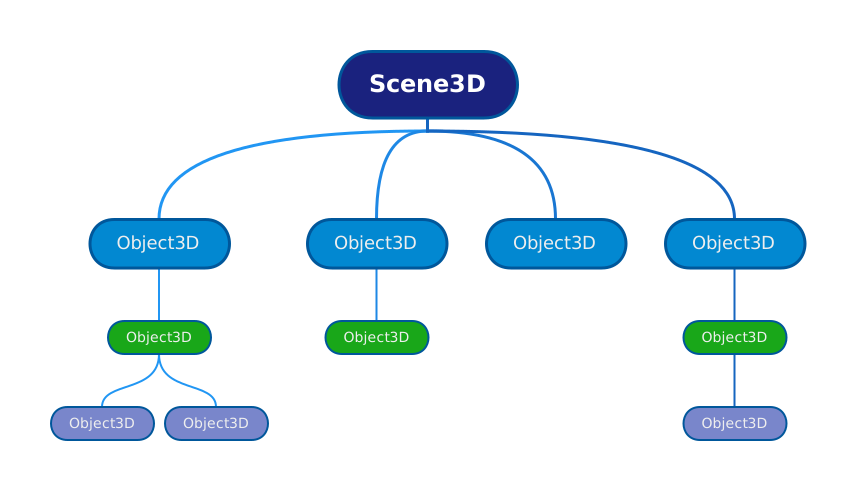
Main functions of Scene3D:
Scene3Ddefines the skybox and environment light map of the scene.Scene3Dcan be used to control and manage the nodes in the scene tree, such as: adding, deleting, and finding nodes.
Basic Usage
let engine = await Engine3D.init();
// Create a scene
let scene = new Scene3D();
// Add a node
let obj = new Object3D();
scene.addChild(obj);
// Add a camera node
let cameraObj = new Object3D();
let camera = cameraObj.addComponent(Camera3D);
scene.addChild(cameraObj);

// Start rendering
let view = new View3D();
view.scene = scene;
view.camera = camera;
engine.startRenderView(view);

// Remove a node
scene.removeChild(obj);Atmospheric Skybox
You can use the AtmosphericComponent component to create an atmospheric scattering skybox:
// Add the atmospheric skybox component, auto generate background and ambient light
let sky = scene3D.addComponent(AtmosphericComponent);See the following example for details:
import { Engine3D, Scene3D, Object3D, Camera3D, AtmosphericComponent, View3D } from '@orillusion/core';
import * as dat from 'dat.gui';

// initializa engine
let engine = await Engine3D.init();
// create a Scene3D
let scene3D = new Scene3D();

// add an Atmospheric sky enviroment
let sky = scene3D.addComponent(AtmosphericComponent);
// set sun position
sky.sunX = 0.8;
sky.sunY = 0.54;
// set exposure
sky.exposure = 1;

// create a camera
let cameraObj: Object3D = new Object3D();
let camera = cameraObj.addComponent(Camera3D);
camera.perspective(60, engine.aspect, 1, 5000.0);
scene3D.addChild(cameraObj);

// create a view with target scene and camera
let view = new View3D();
view.scene = scene3D;
view.camera = camera;

// start render
engine.startRenderView(view);

// debug GUI
const GUIHelp = new dat.GUI({ name: 'Orillusion' });
GUIHelp.addFolder('Atmospher');
GUIHelp.add(sky, 'sunX', 0, 1, 0.01);
GUIHelp.add(sky, 'sunY', 0, 1, 0.01);
GUIHelp.add(sky, 'eyePos', 1000, 2000, 10);
GUIHelp.add(sky, 'sunRadius', 100, 1000, 10);
GUIHelp.add(sky, 'sunRadiance', 0, 20, 1);
GUIHelp.add(sky, 'sunBrightness', 0, 1, 0.1);Use the sunX, sunY, exposure and other properties of the AtmosphericComponent component to adjust the change of the ambient light.
let sky = scene3D.addComponent(AtmosphericComponent);
sky.sunY = 0.54  // The vertical position of the sun, which can adjust the ambient light brightness
sky.exposure = 1.5; // Adjust the ambient light exposure, default value 1
sky.roughness = 0.5; // Set the skybox background blur intensity, range [0, 1], default value 0Auto Follow Light
In addition to manually setting the values of sunX and sunY, the engine also supports automatically adjusting the atmospheric ambient light position to follow the light angle in the scene.
// Directional light
let lightObj3D = new Object3D();
lightObj3D.rotationX = 46;
lightObj3D.rotationY = 62;
lightObj3D.rotationZ = 0;
let directLight = lightObj3D.addComponent(DirectLight);

let sky = scene3D.addComponent(AtmosphericComponent);
// Auto set sunX/sunY by following the directional light
sky.relativeTransform = directLight.transformCustom Skybox
If you want to customize the skybox material texture, you can add a SkyRenderer component to the Scene3D to display a custom background; at the same time, you can set the ambient light through the envMap property of the Scene3D object.
1. Solid Color Background and Ambient Light
You can create a solid color map to set the background and ambient light through SolidColorSky:
import {Scene3D, SolidColorSky, Color, SkyRenderer} from '@orillusion/core';

let scene = new Scene3D();
// Create a solid color map
let colorSky = new SolidColorSky(new Color(0.5, 1.0, 0.8, 1))
// Add the SkyRenderer component, then set the map texture
let sky = scene.addComponent(SkyRenderer);
sky.map = colorSky;

// Set the solid color ambient light at the same time
scene.envMap = colorSky;2. Cross Skybox
You can set the skybox by loading a cross texture cube:
// You can load a complete cross texture cube
let textureCube = engine.res.loadTextureCube('path/to/sky.png')
// Or load 6 separate cube textures
textureCube = engine.res.loadTextureCube([
    'path/to/px.png',
    'path/to/nx.png',
    'path/to/py.png',
    'path/to/ny.png',
    'path/to/pz.png',
    'path/to/nz.png'
])
// Add the SkyRenderer component, set the map texture
let sky = scene.addComponent(SkyRenderer);
sky.map = textureCube;

// Set the ambient light
scene.envMap = textureCube;The cross skybox currently only supports
LDRnormal format images.
3. Equirectangular Skybox
The engine also supports setting an equirectangular type skybox. We can quickly load normal RGBA format LDR images through the built-in res, and also support loading RGBE format HDR images:
// Normal equirectangular texture
let skyTexture = engine.res.loadLDRTextureCube('path/to/sky.png');
// HDR equirectangular texture
skyTexture = engine.res.loadHDRTextureCube('path/to/sky.hdr');

// Add the SkyRenderer component, set the map texture
let sky = scene.addComponent(SkyRenderer);
sky.map = skyTexture;

// Set the ambient light
scene.envMap = skyTexture;4. Transparent Background
If you want to display a transparent background, hide the background by turning off the skybox component. Note that you generally also need to use a transparent Canvas for it to take effect:
// Initialize the engine
let engine = await Engine3D.init({
    canvasConfig:{
        alpha: true, // Use a transparent Canvas configuration
        zIndex: 1
    }
});
let scene = new Scene3D();

// You can add the atmospheric skybox first to get the basic ambient light
let sky = scene3D.addComponent(AtmosphericComponent);
// Then hide the atmospheric skybox, the ambient light will not disappear
sky.enable = falseOf course, you can also not add an atmospheric skybox or background and directly set the ambient light:
// Set a simple white ambient light
scene.envMap = new SolidColorSky(new Color(0.75, 0.75, 0.75));
// Or load an environment map
scene.envMap = await engine.res.loadHDRTextureCube('path/to/sky.hdr');See Scene3D for more detailed usage.